Showing posts with label in60Learning. Show all posts

Sunday, June 24, 2018

Audiobook Review: The Pawnee Indians: Proud Yet Peaceful People of the Stars by HistoryIn60

Title:  The Pawnee Indians: Proud Yet Peaceful People
Author: HistoryIn60
Publication: February 13, 2018 by in60Learning
Genre: Audiobook, History, Nonfiction
Purchase Links: Amazon | Audible

Rating: 4/5

The Pawnee Indians were a fierce, proud, and determined people who called themselves the "men of men". Though there are many Native American tribes to learn about, the Pawnees were unique in many ways; they were a peace-loving, agricultural people with permanent settlements in what is now Nebraska. They dedicated themselves to their gods, the stars, and even arranged their villages according to important star clusters. They fought one notable bloody war with the Lakota, but in 1875, when it came time to make a treaty with the white settlers, the Pawnee packed their bags and left their tribal homeland for a reservation in Oklahoma. Though this displacement has diminished the preservation of their culture, delving into their history is a way to honor it.

First of all I want to say I'm so glad I was offered the chance to listen to this audiobook of The Pawnee Indians. I really enjoyed listening to it. It's only my second audiobook of the year so far, which is already twice more than the previous year. So that's really great on its own for me. Usually I get easily bored or my mind starts to drift when I listen to audiobooks but I'm glad to say this wasn't the case at all with this one. Maybe it was because it was only about an hour long or because the subject was really interesting. It was probably both. 

Starting this book I didn't know anything about The Pawnee Indians although I've always been interested in Native American history. So because of that in every single chapter there were a lot of new things for me to learn. And some things I did learn were pretty surprising to me as well. That's why I love history so much. 

I really liked the narrator, Andrew Colford, as well. He had a great voice and accent to listen to, which also never got boring. And as someone who's first language isn't English I could understand him perfectly, which is always a bonus for me with audiobooks. 

5 interesting facts I learned:

  • The Pawnee Indians practiced human sacrifice.
  • The Pawnee people were deeply religious and didn't convert to Christianity until the late 1800's
  • Family lineage in the Pawnee tradition was matriarchal.
  • Women n Pawnee culture were underplayed but some were entrusted with vital roles.
  • They were warriors but valued peace in their own community. 

Some pictures related to the Pawnee people:

Flag of the Pawnee Nation.
{picture is public domain}

Pawnee father and son (1912)
{picture is public domain}

Pawnee lodges near Genoa, Nebraska (1873)
{picture is public domain}

La-Roo-Chuck-A-La-Shar (Sun Chief) was a Pawnee chief who died fighting the Lakota at Massacre Canyon.
{picture is public domain}


Check out my other in60Learning reviews:


Sunday, March 4, 2018

Review: Kublai Khan: Khan of Mongol, Emperor of China by in60Learning

Title: Kublai Khan: Khan of Mongol, Emperor of China
Author: in60Learning
Publication: February 3rd 2018
Genre: Nonfiction, History
Purchase Link: Amazon
Rating: 4/5

Smarter in sixty minutes.
Get smarter in just 60 minutes with in60Learning. Concise and elegantly written non-fiction books and audiobooks help you learn the core subject matter in 20% of the time that it takes to read a typical book. Life is short, so explore a multitude of fascinating historical, biographical, scientific, political, and financial topics in only an hour each.

As the grandson of the one and only Genghis Khan, Kublai Khan had big shoes to fill. The Mongol Empire already spanned several countries and territories, but this didn’t satisfy Kublai. During his reign, he conquered Southern China, Korea, and several other parts of Southeast Asia, effectively doubling his empire. By the time of his death, people all over Asia and Europe knew his name. This e-book tells the life story of this infamous emperor of both Mongol and China who ruled from the legendary summer palace Xanadu.


In Xanadu did Kubla Khan 
A stately pleasure-dome decree: 
Where Alph, the sacred river, ran 
Through caverns measureless to man 
Down to a sunless sea. 
So twice five miles of fertile ground 
With walls and towers were girdled round; 
And there were gardens bright with sinuous rills, 
Where blossomed many an incense-bearing tree; 
And here were forests ancient as the hills, 
Enfolding sunny spots of greenery. 
—Samuel Taylor Coleridge, 1797


I've had a big interest for a while now in the Khans of Mongol whose empire lasted for almost 400 years. Genghis Khan is one of my favorite figures in history so I was really excited to read this book about his grandson, Kublai Khan who was also a great leader and ruled in the 13th century. I'm very happy to say it was a great read and maybe even my second favorite in60Learning book. 

I almost don't know where to start with this review. I actually took a lot of notes because it was all very fascinating. This book might be short but I feel like a learned so much more about Kublai Khan. It's a great book for those who don't have a lot of time but want to read about him. Once I started reading I couldn't stop until the final page.

I enjoyed all the chapters and it was super interesting to learn that the Mongul empire included: Mongolia, China, Korea, Azerbaijan, Armenia, The Russian Steppes, Khwarezmia (Islamic), Persia, Syria, Georgia, Turkestan, Hungary, Burma, Java and Vietnam. I knew the Mongul empire stretched far and wide but I was really surprised by this.

5 interesting facts I learned:

  • Polygamy was a practice accepted by the Monguls
  • When Kublai Khan died on February 18, 1294, it was the beginning of the end for the Mongul Empire.
  • Kublai Khan wrote some poetry, but most of it is lost to history.
  • Kublai Khan suffered from gout, which appears to have been a hereditary condition among Genghis Khan's children and grandchildren.
  • In the Mongul empire it was customary for the emperor to select his own successor. 

Some pictures related to Kublai Khan:

Painting of Kublai Khan on a hunting expedition, by Chinese court artist Liu Guandao, c. 1280.
{photo is public domain}

Kublai gives financial support to the Polo family.
{photo is public domain}

Longevity Hill in Beijing, where Kublai Khan wrote his poem.
{photo is public domain}

Chabi, Khatun of Kublai and Empress of the Mongol Empire
{photo is public domain}


Check out my other in60Learning reviews:


Thursday, February 22, 2018

Review: The Battle of Thermopylae: 300 Spartans and the Forgotten Citizen-Soldiers Who Fought with Them by in60Learning

Title: The Battle of Thermopylae: 300 Spartans and the Forgotten Citizen-Soldiers Who Fought with Them
Author: in60Learning
Publication: January 22nd 2018
Genre: Nonfiction, History, Ancient History
Purchase Link: Amazon
Rating: 4/5

Most people know about the Battle of Thermopylae, even if they don’t recognize the name. During the second Persian invasion of Greece, 300 Spartans fought against Xerxes I’s forces on a narrow mountain pass. With such cinematic details, no wonder this sensational battle inspired the blockbuster film 300. However, both the film and popular imagination miss many important details about this battle. This concise history sheds light on the thousands of Greek citizen-soldiers who fought alongside the Spartans, forever changing the course of Greek identity and nationhood.


"These [men] are Sparta's walls."
—King Agesilaus when asked why Sparta had no walls.

When thinking of The Battle of Thermopylae most people (myself included) probably only think of the 2006 movie 300 by director Zack Snyder, where a force of 300 Spartans fights the Persians. However, thanks to this book by in60Learning I learned this definitely wasn't the case. It states that many representatives of Greece were present at the battle. Three hundred Spartans did fight there but so did 5700-7200 Grecian hoplites. Hoplites were citizen-soldiers of Greek city-states. 

I love how all city-states, especially the Athenians and the Spartans (since they were the largest power at the time) had their issues with one another but when faced with the threat of the Persian, they came together and fight. I've always had a fascination with ancient Greece, especially Sparta so I thought this book was really fascinating. I basically couldn't read fast enough to absorb all the information. It was all truly compelling and made for a very good read.

At 37 pages it's already a short and straight-to-the-point book, so I flew through it in no time. I can't express enough how these in60Learning books are so easy to read as well as interesting and educational. I'd highly recommend them. Also, although the book is mainly about The Battle of Thermopylae (obviously) it also has some interesting information about the ancient world. I can't imagine that not everyone is at least a little bit intrigued by all of that.

5 interesting facts I learned:

  • The modern adjective 'Spartan', meaning to have an indifference to comforts and luxeries, comes from the lifestyle of the ancient Spartan people.


  • Possessions were held in common. This means that if a Spartan needed to borrow dogs or horses for hunting he could borrow his neighbor's and vice versa.


  • Children were considered the equal responsibility of all. A neighbour was just as free to reward or punish a child, as was the child's own family.


  • The upbringing of children was heavy regulated. When a child was born, the newborn would be presented to the elders of their specific tribe where they would judge the strength and physical structure of the child and then decide whether the child would be kept or exposed to the elements and left to die.


  • Sparta held games and contests of strength and fitness for men and women alike. The women of Sparta were known to work out and keep fit just like the men, which the other Greek city-states found odd.

Some photos and pictures related to The Battle of Thermopylae:

View of the Thermopylae pass at the area of the Phocian Wall. In ancient times the coastline was where the modern road lies, or even closer to the mountain.
{photo is public domain}

Map showing Greek and Persian advances to Thermopylae and Artemisium
{photo is public domain}

Greek phalanx formation based on sources from the Perseus Project
{photo is public domain}

Leonidas at Thermopylae, by Jacques-Louis David, 1814. This is a juxtaposition of various historical and legendary elements from the Battle of Thermopylae.
{photo is public domain}


Check out my other in60Learning review:


More in60Learning reviews to come soon!


Tuesday, February 20, 2018

Review: Alexander the Great: Student of Aristotle, Descendant of Heroes by in60Learning

Title: Alexander the Great: Student of Aristotle, Descendant of Heroes
Author: in60Learning
Publication: January 31st 2018

Genre: Nonfiction, History, Biography
Purchase Link: Amazon

Rating: 4/5

Smarter in sixty minutes.
Get smarter in just 60 minutes with in60Learning. Concise and elegantly written non-fiction books and audiobooks help you learn the core subject matter in 20% of the time that it takes to read a typical book. Life is short, so explore a multitude of fascinating historical, biographical, scientific, political, and financial topics in only an hour each. Long before historians added “the Great” to his name, Alexander stated, “I would rather live a short life of glory than a long one of obscurity.” He certainly lived up to this ambition, conquering most of the known world in just 13 years before his death at age 33. Though undefeated in his lifetime, Alexander died unsatisfied--he always wanted more. His ambitious personality comes as no surprise considering his upbringing: born to powerful parents, he studied under Aristotle and grew up believing himself a descendant of the Greek heroes Achilles and Heracles. His parents and tutors raised him to believe he had something to prove, and this book serves as an account of what he accomplished.

I absolutely love Classical antiquity and I've always been intrigued by Alexander the Great but I have to admit that I actually don't know that much about him. So obviously this was a perfect read for me since I learned so much more about him. This is also the second in60Learning book I have read so far and I haven't been disappointed yet. I've really enjoyed this book!

The book was quick to read like all in60Learning books are but even so it was really interesting and went pretty deep into Alexander the Great, his family and the time he lived in. It was very informative but written in a way that was easy to read and very engaging. 

Alexander the Great: Student of Aristotle, Descendant of Heroes by in60Learning was a really great read. With chapters like 'The Foundation of an Empire', 'Proving his Worth' and 'The Beginning of the End' as well as many more, this book gives its readers a concise yet immersed view on Alexander the Great. 


Bust of a young Alexander the Great from the Hellenistic era, British Museum
{photo is public domain}

Aristotle Tutoring Alexander, by American painter Jean Leon Gerome Ferris
{photo is public domain}

Statue of Alexander in Istanbul Archaeology Museum
{photo is public domain}

Detail of Alexander Mosaic, showing Battle of Issus, from the House of the Faun, Pompeii
{photo is public domain}


Check out my other in60Learning review:
Hatshepsut: The Pharaoh-Queen of Egypt


More in60Learning reviews to come soon!


Friday, February 9, 2018

Review: Hatshepsut: The Pharaoh-Queen of Egypt by in60Learning

Title: Hatshepsut: The Pharaoh-Queen of Egypt
Author: in60Learning
Publication: February 3rd 2018 by in60Learning
Genre: Nonfiction, History, Biography
Purchase Link: Amazon

Rating: 4/5

Smarter in sixty minutes.

Get smarter in just 60 minutes with in60Learning . Concise and elegantly written non-fiction books and audiobooks help you learn the core subject matter in 20% of the time that it takes to read a typical book. Life is short, so explore a multitude of fascinating historical, biographical, scientific, political, and financial topics in only an hour each.

When Pharaoh Thutmose II died, he left an heir far too young to rule Egypt. His widow Hatshepsut stepped up to take his place. For at least the next 20 years, Hatshepsut ruled as Pharaoh King of Egypt in an era of prosperous growth and peace. When she died, her nephew Thutmose III attempted to smear her good name and wipe her memory from history. However, despite his efforts, his aunt Hatshepsut holds the title of most famous native Egyptian woman to ever rule as pharaoh; she also retains a legacy as one of the most successful female leaders in early history.


For those who don't know yet, ancient Egypt is my favorite era in history to read about. I can't remember a time where I wasn't fascinated by anything related to that topic. Hatshepsut is without a doubt my favorite pharaoh. So I'm really glad I got the chance to read this book. Not only was Hatshepsut a woman ruling Egypt as king or pharaoh but she did it for quite some time too (even though she was a co-ruler with her nephew and stepson Thutmose III, who smeared her good name after she died). I've always thought she deserves more recognition by older historians and people in general. I don't think many people will know her very well, or even at all. That's why Hatshepsut: The Pharaoh-Queen of Egypt was a good read. I really enjoyed it!

This book can easily read in one sitting, obviously, like the synopsis says: "Get smarter in just 60 minutes with in60Learning." I did know quite a lot already about Hatshepsut because of my mini obsession with her and the fact that I've alread read a lot about her before this book but even so I can say that it was really good overview about Hatshepsut, her reign, what happened in the aftermath of her death and much more. I even learned a thing or two more that I didn't even know, which is exactly why I love reading these kind of books. 

The writing was really good and informative but the chapters never felt excessively long or too monotonous. It was all pretty precise and to the point, which is something I often feel missing in most nonfiction that I read. 

Hatshepsut: The Pharaoh-Queen of Egypt by in60Learning was a fascinating and well-written introduction for those who want to learn more about Hatshepsut. And one she more than deserves! 


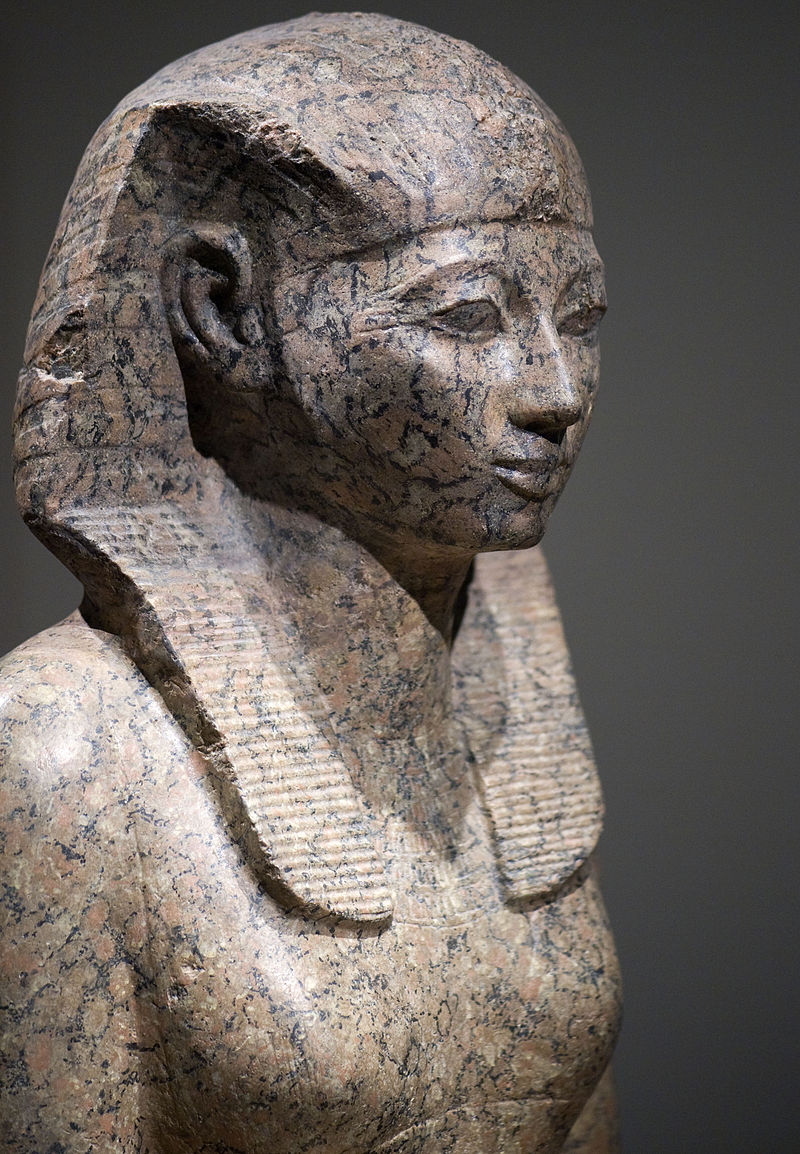
 A stone statue of Hatshepsut
{photo is public domain}

Hatshepsut's mortuary temple complex at Deir el-Bahri.
{photo is public domain}

Relief from Hatshepsut mortuary temple where trees are transported by ship from Punt to Egypt for planting.
{photo is public domain}

Osirian statues of Hatshepsut at her tomb
{photo is public domain}