Showing posts with label biography. Show all posts

Tuesday, November 24, 2026

Review: Livia by Caitlin C. Gillespie

Title: Livia: Mother of Rome
Author: Caitlin C. Gillespie
Publication: July 21, 2026 by Yale University Press
Genre: Nonfiction, Ancient History, Biography
Find it on: Libro.fim | Amazon | Barnes & Noble | Kobo | Waterstones
Rating: 5/5★

A bold new portrait of Livia, ancient Rome’s first First Lady, who shaped the empire from behind the throne

Livia was no ordinary Roman woman. As wife of Augustus and mother of Tiberius―the first and second Roman emperors―she stood at the heart of the first imperial dynasty, wielding extraordinary influence in a world that denied women formal power. In this vivid biography, Caitlin C. Gillespie reclaims Livia (58 BCE–29 CE) from centuries of scandal and rumored villainy, tracing her journey from elite birth and early traumatic exile through her rise to wealth and influence as the matriarch of the imperial household, the Domus Augusta.

Drawing on literary and archaeological sources, Gillespie explores Livia’s inner life through her personal losses, including the death of her son Drusus; her political savvy; and her later life as Julia Augusta, high priestess of Augustus’s divine cult. Though she never held an official political position, Livia emerges as a complex figure whose story of ambition, resilience, and maternal power resonates over millennia, captivating audiences from antiquity through today.


Livia: Mother of Rome by Caitlin C. Gillespie is a biography of Livia Drusilla, one of ancient Rome’s most powerful women, exploring her influence on the Roman Empire, her ambition and her life behind the throne. Drawing on literary and archaeological sources, Gillespie pieces together Livia's life and offers a closer look at the woman behind the historical accounts.

In 39 BCE, Livia divorced her first husband, Tiberius Claudius Nero, while pregnant with their second son, Drusus. Shortly afterwards, in 38 BCE, she married Octavian (later Emperor Augustus), marking the beginning of her rise to prominence within the Roman imperial family.

As I wasn't familiar with Gillespie's work as a classicist, I went into this book without many expectations, assuming it would be a straightforward biography of Livia. However, I ended up absolutely loving it! The writing style was very accessible and easy to follow rather than overly academic, making the historical figures and details enjoyable to read about. I will definitely check out Gillespie's other published works for sure.

I've always found Livia fascinating, but I've generally been more interested in figures like Julia the Elder, Julia the Younger and Agrippina. After reading this book, though, I think Gillespie has officially converted me into a Livia enthusiast! I particularly enjoyed how Gillespie offers a more sympathetic portrayal of Livia than many other books I've read, giving us a chance to see a different side of her.

Livia: Mother of Rome by Caitlin C. Gillespie was an engaging, accessible and thoroughly enjoyable biography. It was just an absolute delight to read! I would highly recommend this book to anyone interested in ancient Rome, particularly the early days of the Roman Empire and the Julio-Claudian dynasty, of which Livia was such an important figure.


About the author:


Caitlin Gillespie is an Associate Professor in the Department of Classical and Early Mediterranean Studies. Previously, she taught at Columbia University in New York and Temple University in Philadelphia. She received her BA in Classics from Harvard University (2005), her Master of Studies in Greek and Latin Languages and Literatures from the University of Oxford (2006), and her PhD from the University of Pennsylvania (2012) with a dissertation on female exemplarity in Tacitus’ Annals.

Professor Gillespie’s research focuses on women of the Roman Empire, with a particular interest in the relationship between gender, power, and politics among women of the ruling family. She has published articles on Boudica, Agrippina the Younger, Epicharis, Livia, Messalina, Agrippina the Elder, and class and gender in the opposition to Nero, among others. Her first book, Boudica: Warrior Woman of Roman Britain (Oxford, 2018) explored representations of Boudica in Roman history and the material culture of first century Britain. She has contributed to several collaborative projects, including articles on women, gender, and motherhood in Tacitus for the Tacitus Encyclopedia, and chapters in edited volumes on women in Cassius Dio, and gender in Sallust. In 2026, she published Livia: Mother of Rome (Yale) and Women and Resistance in the Annals of Tacitus (Cornell). She is currently writing a book on women in the year of four emperors.


Tuesday, February 20, 2018

Review: Alexander the Great: Student of Aristotle, Descendant of Heroes by in60Learning

Title: Alexander the Great: Student of Aristotle, Descendant of Heroes
Author: in60Learning
Publication: January 31st 2018

Genre: Nonfiction, History, Biography
Purchase Link: Amazon

Rating: 4/5★

Smarter in sixty minutes.
Get smarter in just 60 minutes with in60Learning. Concise and elegantly written non-fiction books and audiobooks help you learn the core subject matter in 20% of the time that it takes to read a typical book. Life is short, so explore a multitude of fascinating historical, biographical, scientific, political, and financial topics in only an hour each. Long before historians added “the Great” to his name, Alexander stated, “I would rather live a short life of glory than a long one of obscurity.” He certainly lived up to this ambition, conquering most of the known world in just 13 years before his death at age 33. Though undefeated in his lifetime, Alexander died unsatisfied--he always wanted more. His ambitious personality comes as no surprise considering his upbringing: born to powerful parents, he studied under Aristotle and grew up believing himself a descendant of the Greek heroes Achilles and Heracles. His parents and tutors raised him to believe he had something to prove, and this book serves as an account of what he accomplished.

I absolutely love Classical antiquity and I've always been intrigued by Alexander the Great but I have to admit that I actually don't know that much about him. So obviously this was a perfect read for me since I learned so much more about him. This is also the second in60Learning book I have read so far and I haven't been disappointed yet. I've really enjoyed this book!

The book was quick to read like all in60Learning books are but even so it was really interesting and went pretty deep into Alexander the Great, his family and the time he lived in. It was very informative but written in a way that was easy to read and very engaging. 

Alexander the Great: Student of Aristotle, Descendant of Heroes by in60Learning was a really great read. With chapters like 'The Foundation of an Empire', 'Proving his Worth' and 'The Beginning of the End' as well as many more, this book gives its readers a concise yet immersed view on Alexander the Great. 


Bust of a young Alexander the Great from the Hellenistic era, British Museum
{photo is public domain}

Aristotle Tutoring Alexander, by American painter Jean Leon Gerome Ferris
{photo is public domain}

Statue of Alexander in Istanbul Archaeology Museum
{photo is public domain}

Detail of Alexander Mosaic, showing Battle of Issus, from the House of the Faun, Pompeii
{photo is public domain}


Check out my other in60Learning review:
Hatshepsut: The Pharaoh-Queen of Egypt


More in60Learning reviews to come soon!


Friday, February 9, 2018

Review: Hatshepsut: The Pharaoh-Queen of Egypt by in60Learning

Title: Hatshepsut: The Pharaoh-Queen of Egypt
Author: in60Learning
Publication: February 3rd 2018 by in60Learning
Genre: Nonfiction, History, Biography
Purchase Link: Amazon

Rating: 4/5★

Smarter in sixty minutes.

Get smarter in just 60 minutes with in60Learning . Concise and elegantly written non-fiction books and audiobooks help you learn the core subject matter in 20% of the time that it takes to read a typical book. Life is short, so explore a multitude of fascinating historical, biographical, scientific, political, and financial topics in only an hour each.

When Pharaoh Thutmose II died, he left an heir far too young to rule Egypt. His widow Hatshepsut stepped up to take his place. For at least the next 20 years, Hatshepsut ruled as Pharaoh King of Egypt in an era of prosperous growth and peace. When she died, her nephew Thutmose III attempted to smear her good name and wipe her memory from history. However, despite his efforts, his aunt Hatshepsut holds the title of most famous native Egyptian woman to ever rule as pharaoh; she also retains a legacy as one of the most successful female leaders in early history.


For those who don't know yet, ancient Egypt is my favorite era in history to read about. I can't remember a time where I wasn't fascinated by anything related to that topic. Hatshepsut is without a doubt my favorite pharaoh. So I'm really glad I got the chance to read this book. Not only was Hatshepsut a woman ruling Egypt as king or pharaoh but she did it for quite some time too (even though she was a co-ruler with her nephew and stepson Thutmose III, who smeared her good name after she died). I've always thought she deserves more recognition by older historians and people in general. I don't think many people will know her very well, or even at all. That's why Hatshepsut: The Pharaoh-Queen of Egypt was a good read. I really enjoyed it!

This book can easily read in one sitting, obviously, like the synopsis says: "Get smarter in just 60 minutes with in60Learning." I did know quite a lot already about Hatshepsut because of my mini obsession with her and the fact that I've alread read a lot about her before this book but even so I can say that it was really good overview about Hatshepsut, her reign, what happened in the aftermath of her death and much more. I even learned a thing or two more that I didn't even know, which is exactly why I love reading these kind of books. 

The writing was really good and informative but the chapters never felt excessively long or too monotonous. It was all pretty precise and to the point, which is something I often feel missing in most nonfiction that I read. 

Hatshepsut: The Pharaoh-Queen of Egypt by in60Learning was a fascinating and well-written introduction for those who want to learn more about Hatshepsut. And one she more than deserves! 


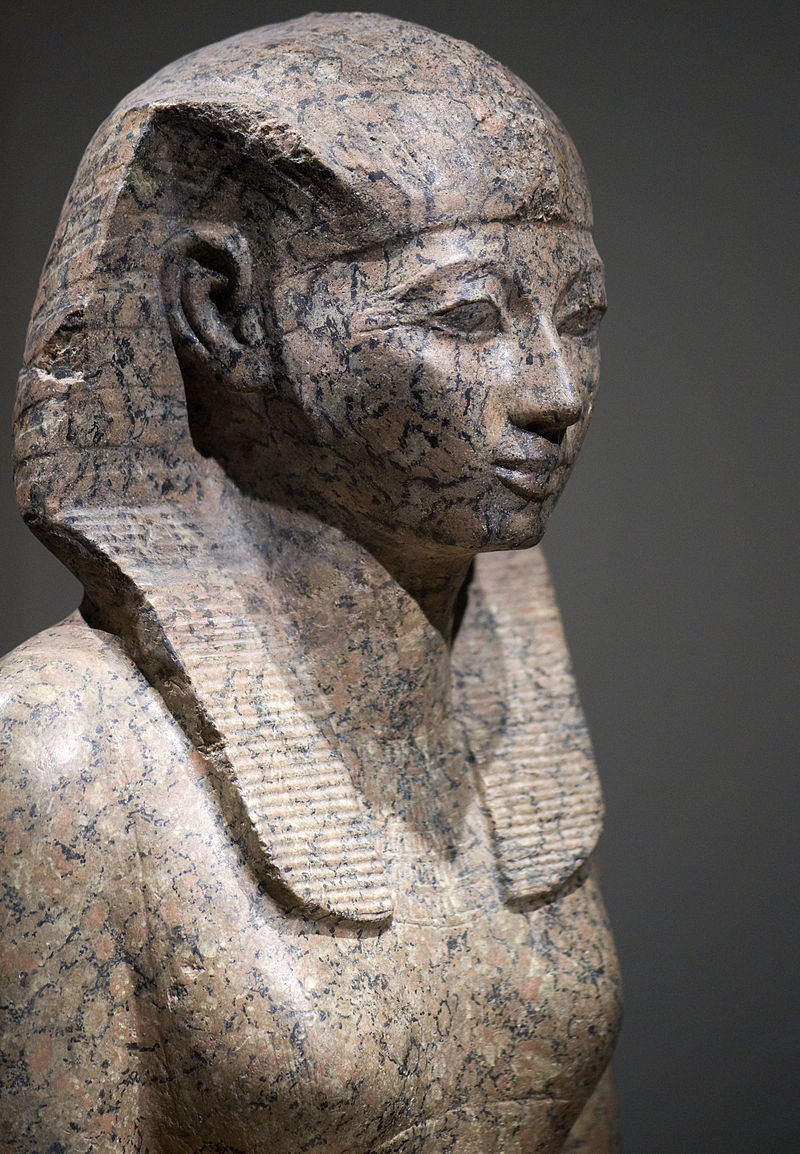
 A stone statue of Hatshepsut
{photo is public domain}

Hatshepsut's mortuary temple complex at Deir el-Bahri.
{photo is public domain}

Relief from Hatshepsut mortuary temple where trees are transported by ship from Punt to Egypt for planting.
{photo is public domain}

Osirian statues of Hatshepsut at her tomb
{photo is public domain}